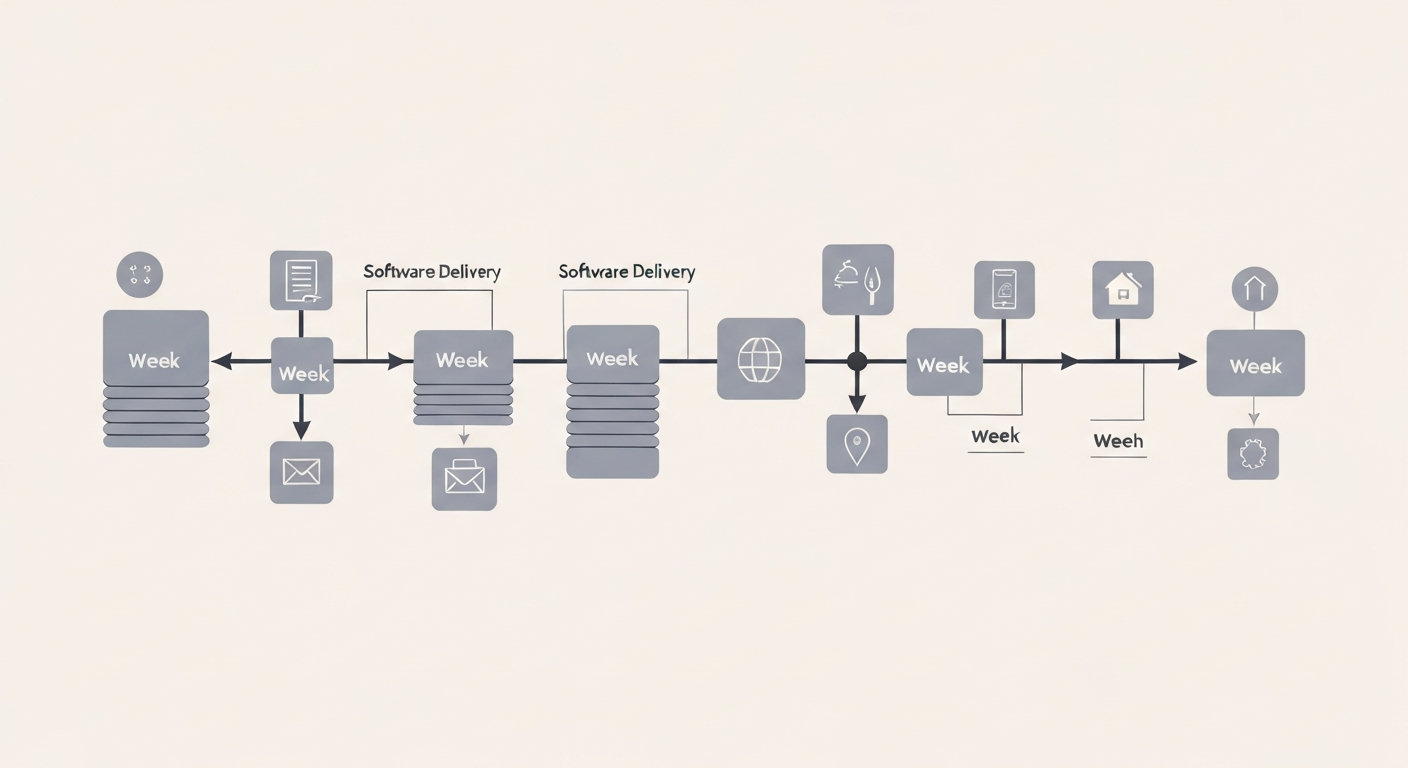
Teams frequently underestimate the timeline for shipping AI/ML projects because they conflate model training with product delivery. A functional model is only one component; integrating it into existing systems, ensuring data pipelines are robust, building user interfaces for interaction, and establishing monitoring and feedback loops are often more complex and time-consuming. This oversight leads to a focus on algorithmics at the expense of infrastructure, deployment, and operational realities, stretching what could be a 30-day proof-of-concept into a protracted, undefined initiative.
Week 0: Pre-Flight
Before any code is written or models are trained, a clear understanding of the problem and the data is critical. This initial phase involves gathering existing documentation and defining success criteria precisely.
- Problem Statement (1 page): Articulates the business problem, the current state, and the desired future state. Example: "Reduce manual invoice reconciliation time by 40%."
- Target Metric & Baseline (quantified): Defines the measurable outcome and the current performance. Example: "Current reconciliation takes 12 minutes per invoice. Goal: 7.2 minutes."
- Data Inventory (spreadsheet): Lists all available data sources, their location (e.g., SQL Server, S3 bucket), estimated volume, and a sample of key fields. This includes data for training, validation, and inference.
- Existing Data Pipeline Diagram (simple flow chart): Visualizes how data currently moves from source to any existing processing or storage, highlighting potential integration points.
- Target System Integration Points (list): Identifies where the AI/ML output will be consumed. Example: "Invoice processing system API endpoint, internal BI dashboard."
- Success Criteria for First Slice (3-5 bullet points): Defines the minimum viable output that demonstrates value. Example: "Model can classify 80% of invoices into 5 categories with 90% accuracy; classification results displayed in a simple web interface."
- Resource Allocation: Confirms dedicated availability of a data scientist, a backend engineer, and a DevOps/MLOps engineer for the project duration.
Weeks 1–2: Foundations
This phase focuses on establishing the core infrastructure and data pipelines required to support the AI/ML solution. The goal is to get data flowing, a basic model trained, and a deployment target ready.

Deliverables:
- Data Ingestion Pipeline (Day 5):
- Activity: Develop scripts using Python with libraries like Pandas or PySpark to extract, transform, and load a subset of the identified training data into a designated working environment (e.g., S3 bucket, Snowflake table). Focus on raw data movement first.
- Tools: AWS S3, Azure Blob Storage, Google Cloud Storage for raw data. Python scripts with boto3 (AWS), azure-storage-blob (Azure), google-cloud-storage (GCP) for programmatic access.
- Verification: Confirm data is accessible and correctly formatted in the staging area.
- Feature Engineering & Dataset Preparation (Day 8):
- Activity: Transform raw data into features suitable for machine learning. Create a consistent training and validation dataset.
- Tools: Pandas for data manipulation, Scikit-learn for basic preprocessing (e.g., one-hot encoding, scaling).
- Verification: Generate descriptive statistics and visualizations of the prepared dataset to ensure data quality and distribution.
- Baseline Model Training (Day 10):
- Activity: Train a simple, interpretable model (e.g., Logistic Regression, Random Forest) on the prepared dataset. This establishes a performance baseline. No hyperparameter tuning yet.
- Tools: Scikit-learn for model training. Jupyter Notebooks or VS Code for iterative development.
- Verification: Report baseline accuracy, precision, recall, or relevant metrics against the validation set.
- Model Packaging & API Endpoint (Day 14):
- Activity: Containerize the trained model and expose it via a REST API. This involves creating a Dockerfile, packaging the model artifacts, and setting up a basic inference endpoint.
- Tools: Docker for containerization, Flask or FastAPI for the API server, Gunicorn or Uvicorn for production-ready serving.
- Verification: Successfully call the API endpoint with sample data and receive a prediction.
Weeks 3–4: Shipping the First Slice
The focus shifts to integrating the model API into a user-facing component and establishing a feedback loop. This demonstrates end-to-end functionality.
- User Interface (UI) for Inference (Day 17):
- Activity: Build a minimal UI (web page or internal tool) that can send data to the model API and display predictions. This can be a simple form submission or a direct API call from an existing application.
- Tools: Streamlit, Flask, React (minimal component), or direct integration into an existing internal application's frontend.
- Verification: Users can interact with the UI, submit data, and see model predictions.
- Integration with Target System (Day 21):
- Activity: Connect the model's output to the identified target system. This might involve updating a database, triggering an action via an API, or populating a report.
- Tools: Python scripts using requests for API calls, SQLAlchemy for database interactions, or specific SDKs for enterprise systems.
- Verification: The target system successfully receives and processes the model's output.
- Monitoring & Logging (Day 24):
- Activity: Implement basic logging for model inference requests, responses, and errors. Set up dashboards to track model usage and API latency.
- Tools: Prometheus for metrics collection, Grafana for visualization, ELK stack (Elasticsearch, Logstash, Kibana) or cloud-native logging (CloudWatch, Stackdriver) for logs.
- Verification: Logs are being collected, and basic metrics are visible in the dashboard.
- Feedback Loop & Retraining Plan (Day 28):
- Activity: Define a mechanism for users to provide feedback on model predictions (e.g., "correct/incorrect" button in the UI, flagging mechanism). Outline a schedule and process for model retraining based on new data and feedback.
- Tools: Simple database table for storing feedback, a cron job or scheduled pipeline for triggering retraining.
- Verification: Feedback can be submitted and stored, and the retraining process is documented.
Signs You're a 30-Day Project / Signs You're a 90-Day Project
Signs you're a 30-day project:

- Data Readiness: Clean, labeled data is immediately accessible in a structured format, requiring minimal preprocessing.
- Clear Problem: The business problem is well-defined, with a single, measurable objective and a clear target metric.
- Existing Infrastructure: There is an established deployment pipeline (e.g., CI/CD for Python services) and readily available cloud resources.
- Simple Model: A basic, off-the-shelf model (e.g., Scikit-learn's Logistic Regression, XGBoost) provides sufficient initial performance.
- Limited Integration: The model integrates with one or two existing systems via well-documented APIs.
- Dedicated Team: A cross-functional team (DS, BE, MLOps) is fully allocated and unblocked.
Signs you're a 90-day project:
- Data Scarcity/Complexity: Data is fragmented across multiple disparate sources, requires extensive cleaning, labeling, or annotation, or involves unstructured formats (text, images, audio).
- Ambiguous Problem: The problem statement is vague, involves multiple competing objectives, or lacks a clear, quantifiable success metric.
- Infrastructure Debt: No existing deployment infrastructure for ML models, requiring significant setup of containerization, orchestration, and monitoring.
- Complex Model Needs: The problem demands custom deep learning architectures, transfer learning, or complex ensembles to achieve even baseline performance.
- Extensive Integration: The model needs to interact with numerous legacy systems, custom APIs, or real-time data streams.
- Resource Constraints: Team members are shared across multiple projects, leading to frequent context switching and delays.
- Compliance/Regulatory Hurdles: The project operates in a highly regulated environment requiring extensive documentation, audit trails, or specific data handling procedures.
Sustaining Momentum Post-Launch
After the initial launch, maintaining momentum involves continuously validating the model's performance in production, iterating on improvements, and expanding its capabilities. Establish a clear cadenced review cycle (e.g., bi-weekly) to assess model drift, review user feedback, and prioritize improvements. Automate data collection for retraining, and ensure the feedback loop informs model updates. This operational discipline ensures the AI solution remains effective and continues to deliver value, preventing it from becoming a static artifact.